

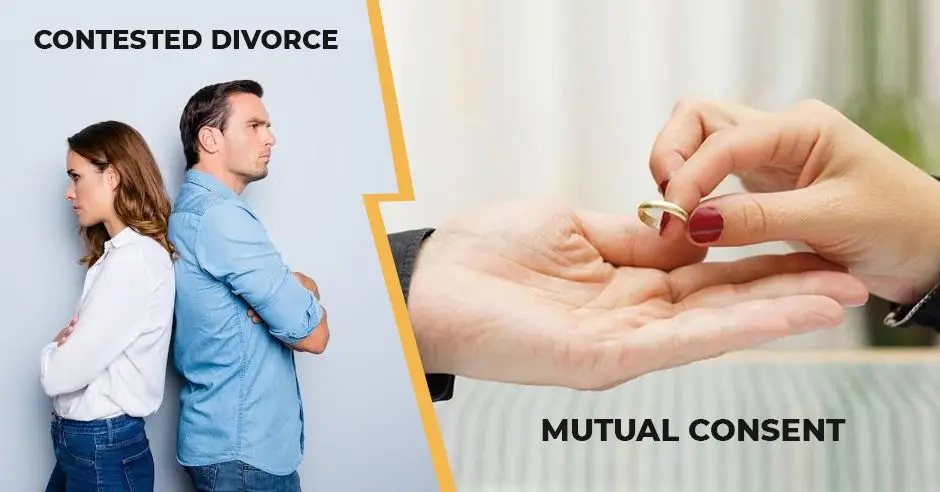
In India, divorce laws are primarily governed by personal laws based on the religion of the parties involved. However, the fundamental types of divorce, applicable even in Haryana, generally fall under two broad categories:
- Mutual Consent Divorce:
- Definition: This is the most amicable and straightforward type of divorce where both husband and wife mutually agree to dissolve their marriage. They don’t need to make any allegations against each other.
- Legal Basis:
- For Hindus (including Sikhs, Jains, and Buddhists): Section 13B of the Hindu Marriage Act, 1955.
- For couples married under the Special Marriage Act, 1954: Section 28 of the Special Marriage Act, 1954.
- For Christians: Section 10A of the Indian Divorce Act, 1869 (requires two years of separation).
- Key Requirements:
- Mutual Agreement: Both parties must agree on the dissolution of marriage and all related terms, including alimony/maintenance, child custody, and division of property.
- Living Separately: They must have been living separately for a period of at least one year immediately before the presentation of the petition. For Christians, this period is generally two years.
- Inability to live together: They must confirm that they have not been able to live together and that the marriage has irretrievably broken down.
- Procedure (General Steps):
- First Motion: A joint petition for divorce is filed by both spouses in the Family Court, along with affidavits confirming mutual consent and the terms of settlement regarding assets, children, etc.
- First Hearing: Both parties appear before the court, and their statements are recorded. The court ensures that the consent is genuine and not under duress.
- Cooling-Off Period: A mandatory cooling-off period of six months is typically granted by the court. This period is for reconciliation, allowing the couple to reconsider their decision. In some exceptional cases, this period can be waived by the court if certain conditions are met and the court is satisfied that reconciliation is impossible.
- Second Motion: After the cooling-off period (or its waiver), if neither party has withdrawn their consent, both spouses appear again before the court. They reaffirm their intention to divorce.
- Divorce Decree: If the court is satisfied that all legal requirements are met and the consent remains mutual and voluntary, it passes a decree of divorce, officially dissolving the marriage.
- Contested Divorce:
- Definition: This type of divorce is filed when one spouse wants a divorce, but the other spouse either does not agree to the divorce or disputes the terms (e.g., child custody, alimony, property division). It is based on specific “fault” grounds.
- Legal Basis:
- Hindu Marriage Act, 1955 (Section 13): Most commonly used for Hindus in Haryana.
- Special Marriage Act, 1954 (Section 27): For civil marriages.
- Indian Divorce Act, 1869: For Christians.
- Dissolution of Muslim Marriages Act, 1939: For Muslim women.
- Parsi Marriage and Divorce Act, 1936: For Parsis.
- Common Grounds for Contested Divorce (applicable under Hindu Marriage Act, 1955, and often mirrored in other personal laws):
- Adultery: Voluntary sexual intercourse by one spouse with any person other than their spouse. (While decriminalized as a criminal offense, it remains a ground for divorce).
- Cruelty: Either physical or mental cruelty that causes a reasonable apprehension in the mind of the petitioner that it is unsafe or harmful to live with the respondent. This can include abusive behavior, false accusations, harassment, or severe emotional distress.
- Desertion: Abandonment of one spouse by the other for a continuous period of not less than two years immediately preceding the filing of the petition, without reasonable cause and without the consent of the deserted spouse.
- Conversion: If one spouse has converted to another religion and ceased to be a Hindu (or their original religion as per their personal law).
- Unsound Mind/Mental Disorder: If the other spouse has been incurably of unsound mind or suffering from a mental disorder of such a kind and to such an extent that the petitioner cannot reasonably be expected to live with them.
- Leprosy (Virulent and Incurable): If the other spouse has been suffering from a virulent and incurable form of leprosy. (This ground was omitted by the Personal Laws (Amendment) Act, 2019, removing leprosy as a ground for divorce).
- Venereal Disease (in a communicable form): If the other spouse has been suffering from a venereal disease in a communicable form.
- Renunciation of the World: If the other spouse has renounced the world by entering any religious order.
- Presumption of Death: If the other spouse has not been heard of as being alive for a period of seven years or more by those persons who would naturally have heard of them if they had been alive.
- Specific Grounds for Wife Only (under Hindu Marriage Act):
- Husband having more than one wife alive at the time of commencement of the Act.
- Husband being guilty of rape, sodomy, or bestiality.
- Marriage solemnized before the wife attained the age of fifteen years and she repudiated the marriage after attaining 15 but before turning 18.
- A decree or order of maintenance has been passed against the husband, and cohabitation has not been resumed for one year or more after such decree/order.
- Procedure:
- Filing Petition: The aggrieved spouse files a petition in the Family Court, citing one or more of the legal grounds, and provides supporting evidence.
- Summons: The court issues a summons to the other spouse (respondent).
- Response/Counter Petition: The respondent files a reply to the petition and may also file a counter-petition.
- Mediation: Courts often refer parties to mandatory mediation to attempt reconciliation.
- Evidence and Cross-Examination: If mediation fails, the case proceeds to trial where evidence is presented, and witnesses are examined and cross-examined.
- Arguments: Lawyers present their final arguments.
- Judgment and Decree: The court delivers its judgment based on the evidence and arguments, and if satisfied, grants a divorce decree. This process can be lengthy and contentious.
Irretrievable Breakdown of Marriage:
While not yet a codified general ground for divorce under the Hindu Marriage Act, the Supreme Court of India, in certain cases, has used its extraordinary powers under Article 142 of the Constitution to grant divorce on the ground of “irretrievable breakdown of marriage,” especially when there is no hope of reconciliation and prolonged litigation would only cause further distress. There have been calls to codify this as a general ground for divorce to streamline the process for couples where the marriage has clearly failed but no “fault” ground can be strictly proven.
It’s important to note that while these laws are uniform across India, the specific procedures, timelines, and interpretations by the High Courts (like the Punjab & Haryana High Court for cases in Haryana) can influence how cases are handled. Consulting a local family law attorney in Haryana is always recommended for personalized advice.